Insurance's Ongoing Flirt with Blockchain

The Insurance Industry's Ongoing Flirt with Blockchain
For the better part of a decade, the case for shared ledgers in insurance has been easy to make. A single risk passes through a broker, a carrier, one or more reinsurers and, increasingly, capital markets investors. Each keeps its own copy of the contract, the exposures and the money owed, and each spends time and money reconciling its copy against everyone else's.
In 2017, Maersk's head of risk and insurance described the problem plainly: "The distance between risk and capital is simply too far." The industry agreed, and spent the following years building ledgers.
The idea was that if every party worked from one shared record of the policy, the premium, and the claims, then the reconciliation pain point would disappear. At the same time, the cost of moving risk from the firms that hold it to the capital that can absorb it would be reduced as well.
But most of these ledgers did not survive. That first decade stalled for two reasons: the industry tried to put records on shared ledgers without putting money there, and it required competitors to agree before anyone could start.
The current wave looks different on both counts. It moves the cash and collateral leg onchain, and it lets one party adopt at a time. Whether this becomes a lasting relationship depends on whether the data describing the risk follows the money.
Timeline: 2016 to 2026
The problem these projects set out to solve is older than any of them. Attempts to modernize the insurance industry began long before blockchain. For most of its history, the London market ran on paper until POSH and LIDS were built in the 1980’s to handle accounting and settlement. Little has changed in terms of infrastructure since then.
A notable attempt to upgrade the system came from Lloyd's, which spent over £70 million in 2001 on an electronic platform that would cut the cost of placing. The project was abandoned by 2006.
The cost of keeping stagnant infrastructure is measurable, however. Lloyd's total expense ratio in 2020 was 37.2% of net earned premium. That’s more than £9.6bn of expenses against roughly £25.9bn of premium. The company estimated that a digital marketplace could save brokers and insurers over £800m a year, equivalent to a 3-point reduction in the market's combined ratio. That figure covers a single marketplace and only the savings Lloyd’s could model. The true cost across the industry is likely higher.
But blockchain promised something beyond digitization. While digitization could put an individual firm’s copy of a process on a computer, a shared ledger could let every firm work from the same copy. That promise began an on-and-off relationship with blockchain technology that has now run for ten years.
Act 1: Courtship (2016–2018)
The relationship began with a consortium when, in late 2016, a group of insurers and reinsurers formed the Blockchain Insurance Industry Initiative, B3i. It explored distributed ledger technology for the industry and over its first years it raised tens of millions of dollars and drew support from many of the largest names in the market.
Capital markets experimented early too. In 2017, Dom Re, a Guernsey-domiciled Insurance-Linked Securities (ILS) vehicle, completed the first issuance of insurance-linked notes digitized on a blockchain.
The high point of the period came in specialty lines. In May 2018, Insurwave, a marine hull platform built by a joint venture between EY and Guardtime with Maersk, Microsoft, Willis Towers Watson, XL Catlin, MS Amlin and ACORD, went into commercial use. Built on R3's Corda, it was expected to support more than half a million automated ledger transactions and help manage risk for more than 1,000 commercial vessels in its first year.
What these efforts shared was a focus on the record. Each one put contracts, exposures or notes onto a shared ledger. The problem was that none of them put the premium, the claims payments, or the collateral there.
Act 2: Disillusionment (2019–2023)
Lloyd's, meanwhile, chose a different path when it published Blueprint One in 2019 and Blueprint Two in 2020. It was a market-wide program to replace core processing with a central data record and digital gateway built on conventional, centralized technology. It would go on to stall for reasons that had little to do with that choice of technology, and much to do with coordination.
B3i reached its own milestone in April 2022, when Allianz and Swiss Re placed the first legally bound Cat XoL reinsurance contract on distributed ledger technology using its platform. Three months later, in July 2022, B3i filed for insolvency after failing to raise new capital. Its directors concluded, after consulting shareholders, "that there was not sufficient support to continue with the venture at this stage."
The explanation from one of its original backers was commercial, not technical. "I think it was a very quality effort, but at the end of the day, we did not see the volumes in the demand that would have justified continued investment in this platform," said John Dacey, group CFO of Swiss Re. B3i's shareholders were also its intended customers. When it came time to fund the next stage, none of them committed the volume, or the capital, to keep it going.
Outside the incumbent market, however, Nexus Mutual was reimagining the whole stack. Launched in 2019, its structure was a discretionary mutual governed by its members as a DAO with capital visibility pooled onchain in ETH and other tokens. Nexus Mutual also covered new kinds of risk such as smart contract failure.
Since launch, Nexus Mutual members have paid more than $18.5 million in claims, including losses from the FTX collapse. The company has proved that capital, governance, and claims can all live onchain.
Act 3: The return (2024–2026)
The return began quietly. In 2024, Schroders Capital and Hannover Re tokenized a portfolio of reinsurance contracts on a public blockchain as an internal-only proof of concept.
At the same time, a new category of company appeared: the onchain reinsurer. OnRe and Re built vehicles that take in stablecoin capital, deploy it into real reinsurance contracts and return premium to depositors.
Lloyd's, by contrast, kept slipping. In September 2025, Lloyd's CEO Patrick Tiernan said the re-platforming element of Blueprint Two would not be completed before 2028, and committed to keeping the heritage systems operationally resilient until at least 2030. By March 2026, the program had been sunset.
A month later, the Schroders and Hannover Re live transaction closed. In May 2026, OnRe raised a $5M Series A co-led by Forward Industries and RockawayX.
Today's insurance landscape
Ten years in, the approaches gaining traction have learned from previous initiatives and solve two problems the first wave left open:
- Coordination: A permissioned, private ledger is only useful once enough counterparties have joined it. New approaches let a single cedent, investor or vehicle adopt on its own terms.
- Cash: A ledger that records a premium owed, but cannot move the premium, still leaves every party reconciling against bank statements. New approaches move the collateral and settlement through the same system that holds the record.
This is what the map looks like today:
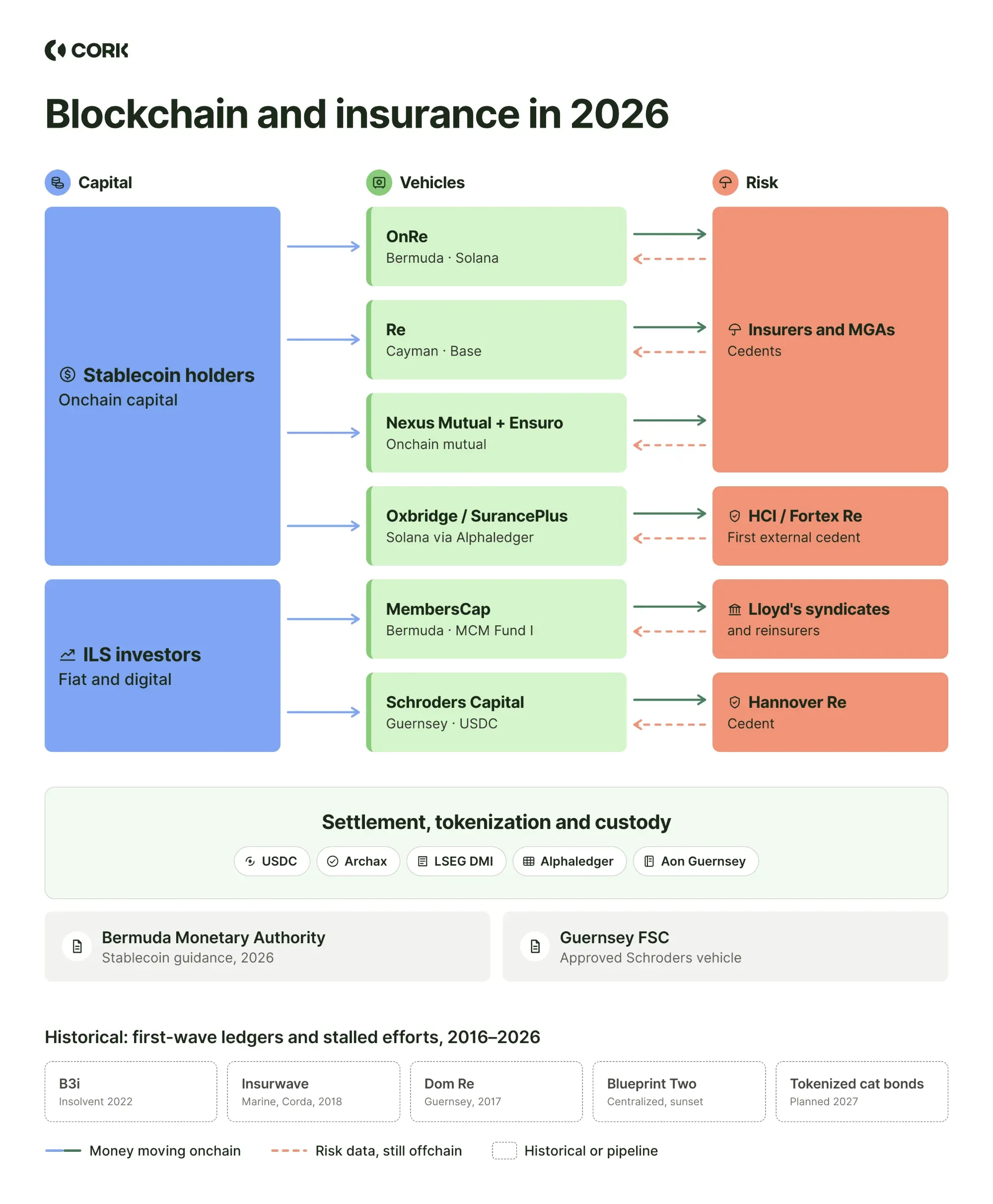
Why the resurgence is structurally different
1. The cash leg now exists
In collateralized reinsurance, the reinsurer (often an ILS fund) posts collateral equal to its full limit, usually held in a trust account for the life of the contract and typically invested in cash or Treasury money market funds. In the Schroders and Hannover Re deal, the collateral was held in USDC and invested in a Schroders money market fund. The yield is similar to a conventional trust’s. What changes is that the collateral can be posted, valued and released by smart contract, and the cedent can check it at any moment instead of waiting for a trustee statement.
This addresses a long-standing inefficiency in collateralized reinsurance, where trust balances typically sit dormant for the life of a contract. BIS research finds that tokenized money market funds can generate returns "for each instant of time at which collateral was held," because smart contracts allow continuous rebalancing without intermediaries.
2. Adoption is not consortium-based
The Hannover Re deal only needed two parties, a regulated custodian and a jurisdiction willing to approve the structure. It did not need an industry body to agree on a standard first, solving the coordination problem that existed in consortium models.
Likewise, Hannover Re's assessment was that the deal "demonstrated that the associated regulatory and operational risks are comparable to those encountered in traditional market transactions." That comparison is an important threshold for reinsurers.
Lloyd’s has reached a similar conclusion about its own market. Its post-Blueprint strategy drops the single mandated platform. Patrick Tiernan described the new approach as “an ecosystem of intelligent solutions, built on common data standards and interoperability.”
3. Regulated structures now exist
The new vehicles operate inside existing regulatory frameworks rather than around them. OnRe is licensed in Bermuda under both the Bermuda Insurance Act and the Digital Asset Business Act. The Schroders and Hannover Re reinsurance entity is managed by Aon Guernsey, which secured approval from the Guernsey Financial Services Commission. Archax, a regulated digital asset platform, acted as broker and provided the tokenization and custody that gave the structure access to money market fund yield.
4. A new pool of capital has appeared
Alongside traditional ILS investors, stablecoin holders are now a source of reinsurance capacity. Re has written over $500 million in premium to date, backing close to a million U.S. households. OnRe’s yield-bearing token, ONyc, has grown from $30M to $300M.
These are small numbers against a reinsurance market measured in hundreds of billions, but they come from a pool of capital that had no route into reinsurance at all five years ago.
The opportunity
These developments leave an open opportunity. Up to this point, we’ve seen approaches that solved either the coordination problem or the cash problem. Now we have the space for initiatives that piece everything together and solve both issues.
| Ledger of records | Ledger of money | |
| Consortium adoption | B3i, Insurwave, RiskStream | Largely empty |
| Single-party adoption | Fizzy and Etherisc | Schroders and Hannover Re, OnRe, Re, Nexus Mutual |
What would turn a flirt into a commitment
The new wave has not proven itself yet.
The important development of the past two years is that the money has started moving onchain and collateral can now be held, invested, and verified in real time. However, the risk that collateral backs cannot. Exposures, premium and claims still move through bordereaux, spreadsheets, and quarterly statements, with each party maintaining its own version.
The industry has shown it can put money on a shared ledger without asking the whole market for permission. Whether this becomes a lasting relationship depends on whether the data describing the risk follows the money. This is where the next phase will be decided.
Learn more about what is possible for the insurance industry using Cork technology.