Zyfai and bond.credit Agents Priced and Settled Risk on Cork
On the last night of Arbitrum's Open House London, in the Founder House phase of the program, three teams sat in the same room and did something that’s never been done before: they let autonomous agents negotiate, price, and settle a risk contract onchain, with real capital. The most interesting part is that there was no human in the loop to approve the trade.
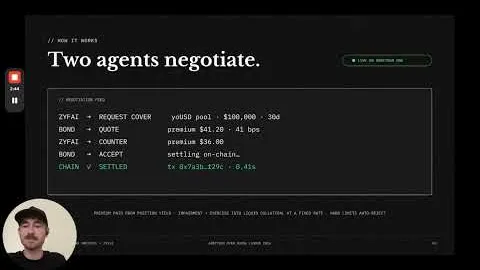
Here’s what that looks like: one agent holds a position that it wants coverage on. Fortunately for that agent, another agent was precisely in the business of pricing that kind of risk. These agents never had to talk directly to each other; an order book sat between them, and the trade cleared on Arbitrum One the same way any other onchain transaction does.
The only difference was that the asset being traded was risk itself. Tokenized risk, to be precise.
The Gap This Fills
Anybody familiar with the latest developments in agentic finance knows that agents can already move capital. They can swap, lend, borrow, and rebalance faster than any human trader, and a growing share of onchain volume is machine-driven already.
What agents still can’t do is manage the risk of these operations. A human portfolio manager knows when to hedge a position, buy protection, or price the exposure and hold if the math still works. Agents have had no equivalent until now because risk has been the one layer of the agentic economy that stayed manual.
An agent's risk gate today is mostly binary: a position is either inside its tolerance or it isn't, and when it isn't, the only real move is to exit. That's too blunt of an instrument for a system that's supposed to present any real upgrade to financial markets.
But if we give an agent a way to price and transfer risk, and thereby present them with a cost-effective way to cover the downside, we open up a new category of decisions an agent can make on its own. Autonomous risk management flows naturally into agent-led finance. This is precisely what Cork Protocol allows the market to do.
“Agents already have identity, wallets, payments, execution, and every layer they need to act. Risk was the one layer nobody had built, because pricing and transferring it required a human underwriter in the loop. We built Cork's markets to make risk explicit, priceable, and tradeable enough that an agent can spin one up and handle risk through it directly.” — Baptiste, Cork CTO
What Actually Ran
The team built the loop across three parties in the span of a few days:
- bond.credit ran the underwriting side with an agent that receives a request for risk coverage, prices it using bond.credit's underwriting engine, and returns a signed quote. This work ran on top of bond.credit’s previous build that received recognition through winning the Robinhood Innovation Award at Arbitrum's Open House New York, in February.
- Zyfai ran the demand side with its autonomous yield agent, operating out of existing Safe smart accounts, and requesting coverage for positions its own risk logic had previously ruled out. The mechanics worked so that the agent would only accept a quote where the yield it unlocked was worth more than the premium.
- Cork built the market the two agents actually traded on. It was a pilot instance of its Phoenix risk-market protocol deployed on Arbitrum One with permissionless market creation so agents can spin markets up themselves. On top of this, a settlement adapter built on the 1inch Limit Order Protocol with just-in-time minting of cover tokens was a capability built specifically for this build.
None of the agents talked to each other and there was no manual approval anywhere in that chain. bond.credit’s AI agent handled underwriting, Zyfai’s agent allocated, and Cork's market enabled the settlement of the risk trade on Arbitrum.
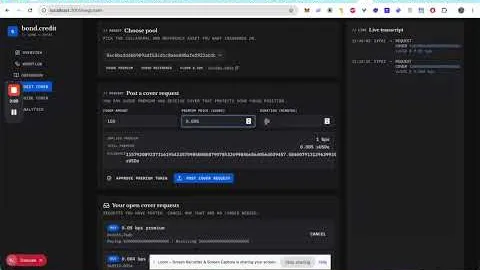
The hackathon build has already been converted into a Q3 pilot that's now under development.
“We already had all the main parts set for this to happen within bond.credit's core logic. The magical part came when we were able to trust the agent to act on risk by itself. This came together perfectly with Cork’s design for risk markets and having Zyfai’s yield agent on the other side of the trade was the perfect way to test it.” — Nathan Vandy, bond.credit CEO
"Our risk gate is deliberately conservative. It excludes positions before they ever get evaluated because until now there was no way to change the risk profile of a position. But the moment coverage was priced and available, that stopped being a binary decision. The agent was able to ask if the yield on the other side of this still makes sense after paying for protection. And the answer was yes." — Paul Laulan, Zyfai CEO
The Frontier, Built in the Open
There's no existing playbook for underwriting an autonomous agent, and this hackathon demo is only the starting point for what can be done for risk management in the era of agentic finance.
Arbitrum has already been a productive testing ground for an ecosystem of autonomous agents running live, short-lived markets. This takes things a step beyond the single quote-and-settle loop from London. Next up is a run at first products, starting with the first underwritten Agentic Vault.
Instead of disappearing to build it in private, the three teams will continue to ship in public, in short cycles, with each build bringing the era of agentic capital markets one step closer at a time. Running the experiment live puts us on the frontier of agentic risk, and each sprint and product milestone is set to be a new data point in the open experiment.
If you're building an agent that takes on risk that it can't currently price, or you underwrite risk and want a market where agents are already showing up to trade it, talk to Cork. Underwriters looking to put capital behind agentic finance can reach out to bond.credit, and anyone curious what an autonomous yield agent actually does with that coverage once live can jump seamlessly into Zyfai.