
April 2026
10 minutes
What Is a Liquidity Buffer? Understanding DeFi’s Missing Primitive
There is a fundamental tension in finance between yield and liquidity known as the liquidity preference theory. It states that money has a preference for liquidity because the hurdle rate for illiquidity is generally higher. However, higher returns typically require higher risk, which typically comes in the form of opportunity costs created by illiquidity. In practice, this means that higher returns typically require market participants to lock capital in less-liquid assets.
But there’s a fundamental problem here: when stress hits, everyone wants immediate access to their funds.
In traditional finance, institutions solve this by maintaining reserve assets, even though holding cash is costly. They even have mandated requirements to maintain liquid asset reserves for this reason. These assets work as a liquidity buffer that helps institutions stay afloat in the midst of dramatic market downturns.
The onchain world is still working on similar solutions, however. In this post, we will explore what these liquidity buffers really are and how they can be implemented in decentralized finance (DeFi) markets.
What Liquidity Really Means
Liquidity isn’t just the ability to eventually sell an asset. It means accessing value at par, immediately. This is especially important under stress situations. If liquidity is not available when needed, market participants are suffering from what’s known as liquidity risk.
Fundamentally, this risk often arises from duration mismatch that translates to an opportunity cost of not being able to easily access other markets with the locked-in capital. A more common outcome happens when the assets a protocol or institution holds mature slower than its liabilities, however. In DeFi, this can show up in vaults promising instant redemptions while holding underlying assets with long settlement windows, for example.
This is not a problem most of the time. However, liquidity risk can produce scenarios where protocols struggle to meet withdrawal demand when too many users exit at once.
Real-World Examples of Liquidity Buffers
Traditional finance has long relied on strategies to solve duration mismatch:
- Bank Reserves: Basel III mandates that banks hold enough HQLA to cover one month of stressed outflows.
- Money Market Funds: U.S. regulations now require MMFs to hold 25% of assets in daily liquidity and 50% in weekly liquidity. Additionally, they implement mechanisms such as swap lines and credit lines.
- Insurance Companies: In Q1 2020, U.S. life insurers increased cash holdings by $90 billion (a 75% jump) to prepare for COVID-induced liquidity demands.
- Liquidity Swaps: When central banks lack liquidity for a specific foreign currency, they borrow from that currency’s central bank using their own currency as collateral and agree to reverse the trade later at an interest-adjusted rate.
- Lines of Credit: Individuals, businesses, and even governments often resort to credit facilities that can be offered ad hoc by banks and other financial institutions in the event of a liquidity crisis.
These strategies are effectively defined as liquidity buffers. They are purpose-built mechanisms designed to meet redemption requests even when markets freeze or underlying assets can't be quickly liquidated. Typically, they can be built in two ways:
- Internal Buffers: Capital set aside from within the vault, reducing the total capital deployed in yield strategies.
- External Buffers: Liquidity sourced on-demand from third-party LPs or external mechanisms, allowing full capital deployment while retaining redemption flexibility.
Liquidity Buffers in DeFi Today
In DeFi, particularly in vault settings, liquidity buffers would ideally ensure users can exit without delay or discount, even when the vault's core strategy holds longer-duration or less-liquid assets.
Unlike traditional finance, where mandated reserve requirements and central bank facilities provide a structured safety net, DeFi has had to develop liquidity solutions organically, protocol by protocol. The approaches that have emerged fall into several distinct categories, each with meaningful trade-offs across capital efficiency, redemption speed, composability, and resilience under stress.
- Internal reserve buffers are the most direct approach. Protocols like mETH allocate a portion of TVL into liquid lending markets like Aave, creating a two-speed redemption system: an instant buffer for smaller exits, and standard queue-based withdrawals for larger ones. The trade-off is that capital held in reserve isn't deployed in higher-yield strategies, and buffers deplete quickly under concentrated outflow pressure. Aave's kinked interest rate model takes a softer version of this approach, creating economic pressure that organically preserves pool liquidity, but it doesn't guarantee instant exit for vault depositors.
- Withdrawal queues sacrifice speed for capital efficiency. Restaking protocols like EigenLayer and liquid staking providers like Lido rely on structured unbonding windows During peak network activity, Ethereum's native exit queue extended beyond 40 days. These queues are operationally simple and allow full capital deployment, but they are incompatible with the liquidity expectations of institutional allocators.
- ERC-7540, finalized in 2024, established a standard for asynchronous redemptions across ERC-4626 vaults defining a three-stage flow with Pending, Claimable, and Claimed statuses that accommodates T+1 to T+5 settlement windows. Lagoon Finance built its entire 800-vault infrastructure on ERC-7540. This was a critical infrastructure unlock for the RWA vault category since it created a common redemption interface that aggregators, frontends, and downstream protocols could all integrate against. The standard improves interoperability significantly, but it addresses the mechanics of delayed redemption rather than eliminating delay.
- Secondary market exits via platforms like Pendle and Curve offer an alternative path. Instead of redeeming directly from a vault, depositors sell their position into an AMM pool. Pendle's yield tokenization layer allows users to trade principal and yield claims independently, enabling near-instant exits at market-determined prices. Curve's StableSwap pools provide similar relief for pegged assets like stETH. The limitation is structural: secondary market liquidity is shallow and pro-cyclical. During stress events, exactly when users need to exit, pool depth shrinks and slippage spikes. Secondary markets simply redistribute liquidity.
- Multi-venue instant redemption, pioneered by RWA issuers like Ondo Finance's OUSG, addresses this by building redundant, always-on off-ramps. OUSG provisions multiple stablecoin liquidity pathways so that if one facility is constrained, others remain active. This model proved its value in March 2025, when a 23-hour outage in BlackRock BUIDL's Circle redemption facility caused limited disruptions for single-venue products while Ondo's backup channels continued to function. The cost, however, is that facility provisioning and counterparty agreements reduce net yield.
- Flash loan and credit facilities like Maker, Aave GHO, and Spark offer high capital efficiency and atomic settlement, but they are structurally suited to arbitrage and short-duration unwinds rather than sustained redemption demand. They do not solve for multi-day or structural liquidity mismatches.
The table below summarizes how each approach performs across the dimensions that matter most to vault operators and institutional allocators:
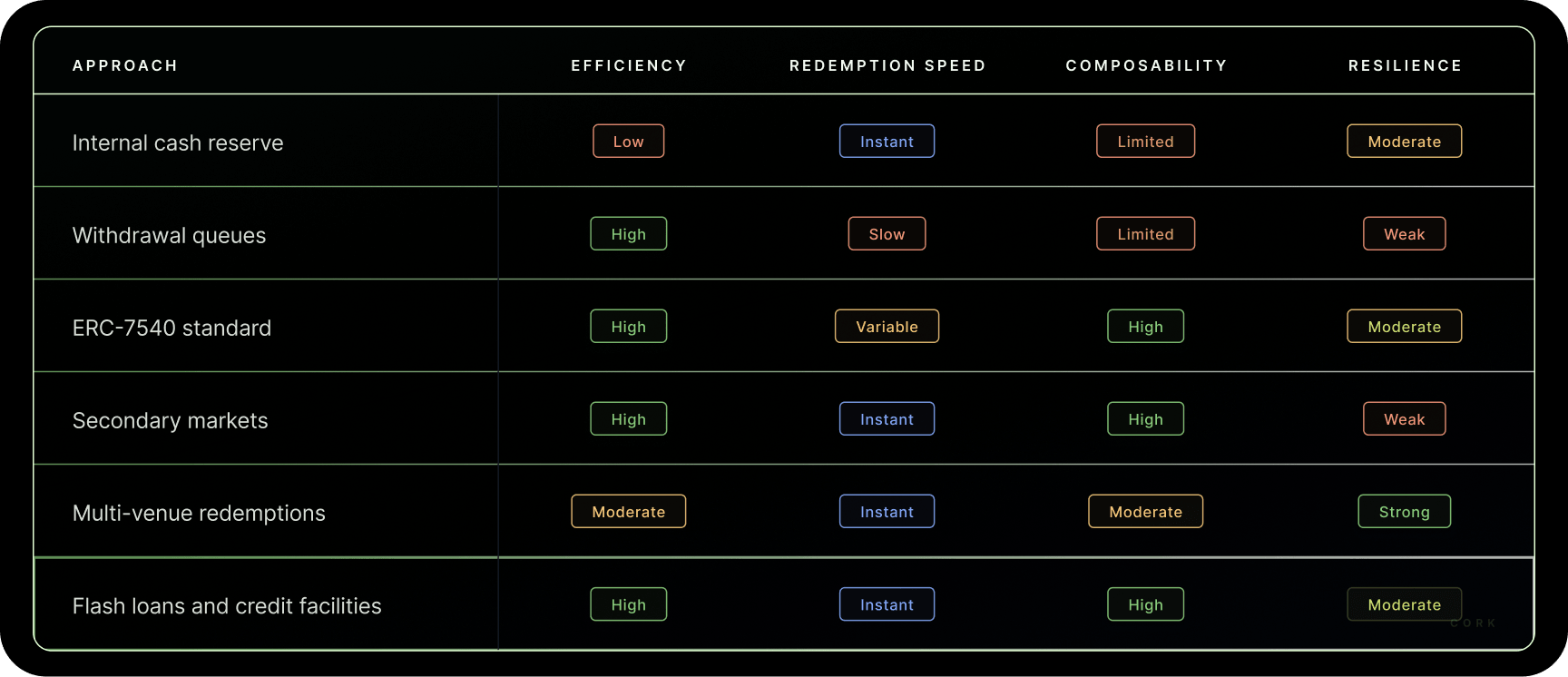
A clear pattern emerges where no single existing approach is simultaneously capital-efficient, instant, composable, and resilient under stress.
Liquidity Buffers as an Onchain Primitive
What the market has lacked is an external buffer primitive that decouples redemption guarantees from internal capital allocation, and that functions independently of market depth or counterparty availability. For vaults holding RWAs, long-duration instruments, or any asset with a settlement window, the absence of this primitive has been the binding constraint on institutional adoption.
Moreso, the growth of market sectors like onchain vaults make liquidity risk a first-class concern. ERC-4626 vaults held over $16 billion across hundreds of protocols by the end of 2025. Solving this risk allows them to expand into new opportunities like RWAs which surpassed $28 billion in value on public chains as of early 2026 and represent a total addressable market of $600 trillion.
These vaults often hold multi-day or multi-week instruments. Without an onchain liquidity buffer primitive, redemptions must be gated, delayed, or settled OTC. This limits composability and deters large or institutional capital allocators.
Having liquidity buffers as an onchain primitive, in turn, allows vaults to offer faster redemption without sacrificing capital deployment. Rather than being yield enhancers or insurance, they should be seen as a risk management primitive: a protocol-level abstraction that allows yield strategies and liquidity needs to be priced and separated.
If we go back to the table above, this is how an onchain liquidity buffer performs:

Onchain Liquidity Buffers in Action: Agglayer x Cork
Agglayer's Vault Bridge is a good example of how the tension between capital efficiency and redemption liquidity surfaces in vault strategies. The bridge deposits collateral from connected L2s like Katana into Morpho vaults on Ethereum mainnet, generating a non-inflationary yield stream that chains redeploy as ecosystem incentives.
Katana has generated over $3.7 million in Vault Bridge revenue through this model. However, available liquidity for instant withdrawals can be thin under high utilization rates. So far, this hasn’t presented any issues, and the Agglayer team has taken necessary steps to ensure this continues to be the case by integrating Cork’s onchain solution for liquidity on-demand.
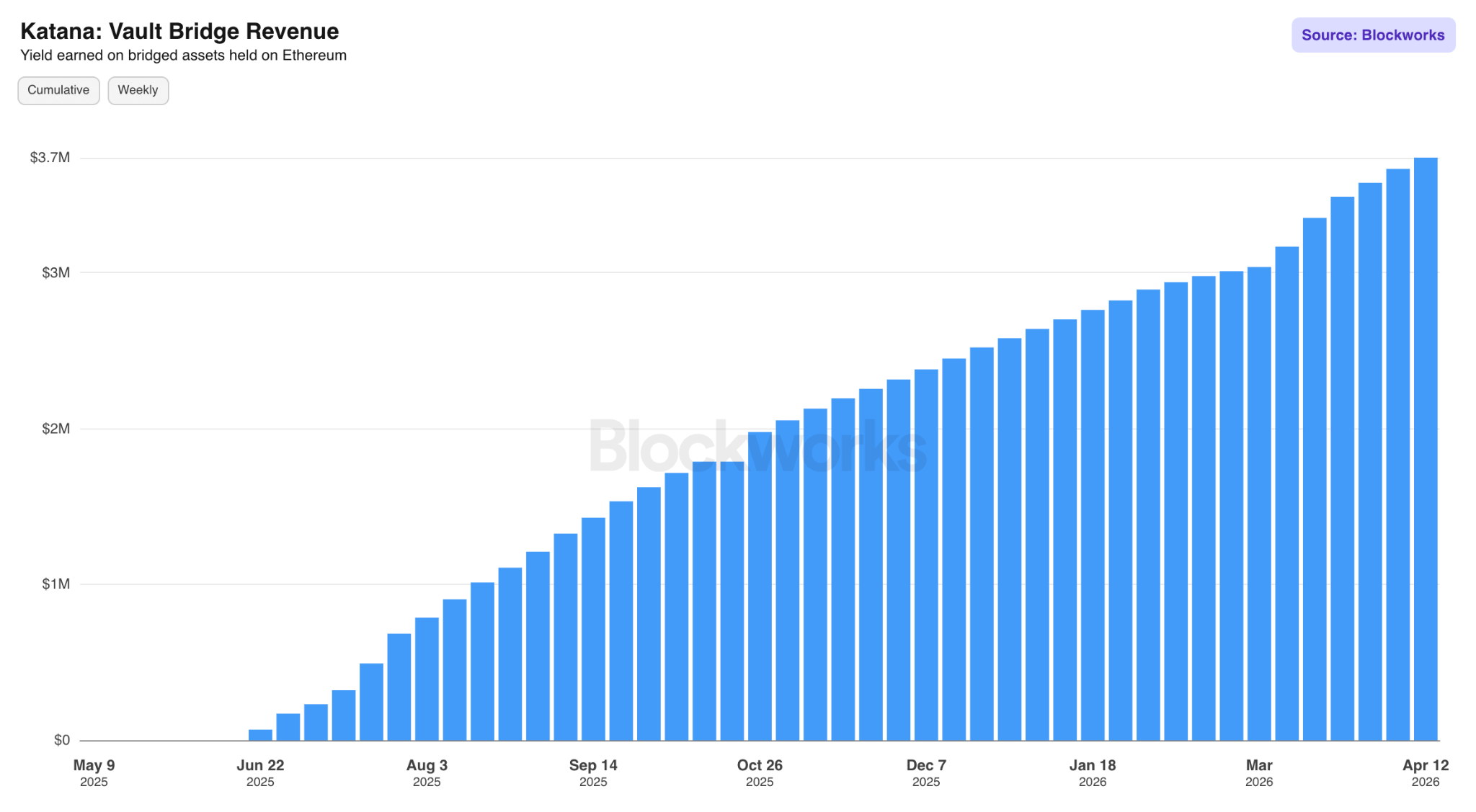
Katana Vault Bridge Revenue via Blockworks
Cork's integration with Vault Bridge addresses the worst-case scenario of a liquidity crunch directly. Liquidity providers deposit stable assets into a Cork Pool, and Agglayer purchases fully-collateralized Cork Swap Tokens against that pool. When withdrawal demand spikes, those tokens guarantee instant redemptions regardless of how much underlying collateral is currently deployed because the buffer activates independently of market depth, Morpho utilization rates, or broader conditions.
Unlike an internal reserve approach, which would require Vault Bridge to hold back a portion of collateral from yield strategies, Cork's external buffer leaves capital fully deployed while the redemption guarantee remains intact.
The results work for everyone involved. LPs earn native yield plus a risk premium for providing that guarantee, meanwhile Agglayer gets institution-grade redemption predictability without sacrificing the yield model that makes Vault Bridge worth integrating in the first place. Katana users get instant withdrawals.
In short, an onchain liquidity buffer allows for the yield layer and the liquidity layer to be separated, priced independently, and each optimized on its own terms. It's a template that applies anywhere duration mismatch creates friction between capital deployment and redemption demand.
The Future of DeFi with Programmable Liquidity Layers
In the future, we may see buffers become programmable and composable, deployed via smart contracts, priced dynamically by the market, and integrated across onchain vaults. They could also open previously unfeasible strategies like looping for long-term duration assets.
As tokenization, vault protocols, and digital asset managers continue to scale and onchain yield strategies mature, liquidity buffers will become a key design layer. Instead of manual reserves, vaults will integrate programmable buffers that are flexible, composable systems that provide redemption liquidity on demand.
DeFi is entering an era where liquidity itself is a market, using liquidity buffers as the foundation. Dive deeper into the concept by jumping into the docs or contact us and explore integrating a Cork liquidity buffer.
Follow Cork on X or LinkedIn. Read more about onchain risk management in DeFi:
- Cork x Agglayer | Instant Withdrawal Liquidity
- Demystifying Onchain Vaults and the ERC-4626 Token Standard
- Assessing Liquidity Risk in DeFi
- Inside the Onchain Vault Ecosystem: Asset Issuers, Protocols, and Risk Curators

